Books About the Southwest: History, Fiction, and the Stories We Were Never Told
March 7, 2026 · 8 minutes read
The American Southwest has been mythologized so thoroughly and for so long that the myth has become almost impossible to see around. These books are a corrective.
The American Southwest is one of those places that has been mythologized so thoroughly and for so long that the myth has become almost impossible to see around. The story most of us inherited involves frontiers and destiny and a kind of clean westward logic, a narrative so useful to the people who wrote it that they just kept writing it, in textbooks and westerns and national park brochures, until the land itself started to seem like it had always been waiting for this particular ending. It had not. The books on this list are a corrective to that story, and reading them together does something that reading them separately does not: it builds a picture of a region with thousands of years of urban civilization, political complexity, and cultural continuity that survived contact, colonization, and the active machinery of erasure. Some of these are fiction, some are history, some move between the two because the two have never been cleanly separable here. What they share is an insistence on looking at the Southwest as it actually was, and is, rather than as it has been sold to us.
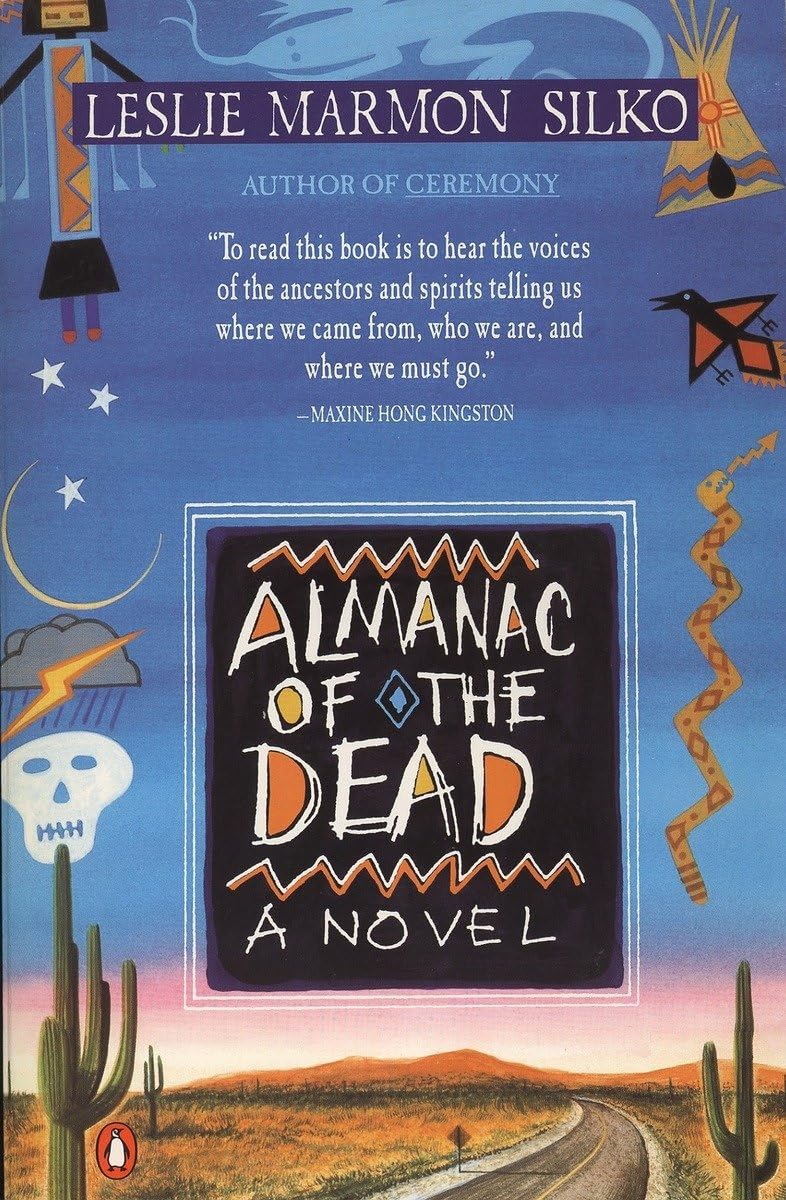
Almanac of the Dead by Leslie Marmon Silko
Seese arrives in Tucson looking for her missing child after the drug world she lived in collapsed around her. She finds Lecha, a psychic ducking the fallout from her own fame, who has a more pressing job: transcribing a set of ancient notebooks that contain the history of her people — a Native American record of the dead.
The story fans out from there. Through Lecha’s extended family and the violent, tangled lives orbiting them, Silko builds a portrait of the Americas as a place where two timelines exist at once — the contemporary Southwest and the deep past of indigenous peoples — and where that collision produces something that is neither resolution nor peace. It’s a long book, an uncomfortable one, and it asks you to hold a lot. What it’s really about is what survives: not just people, but ways of seeing the world that the modern one has tried to bury.
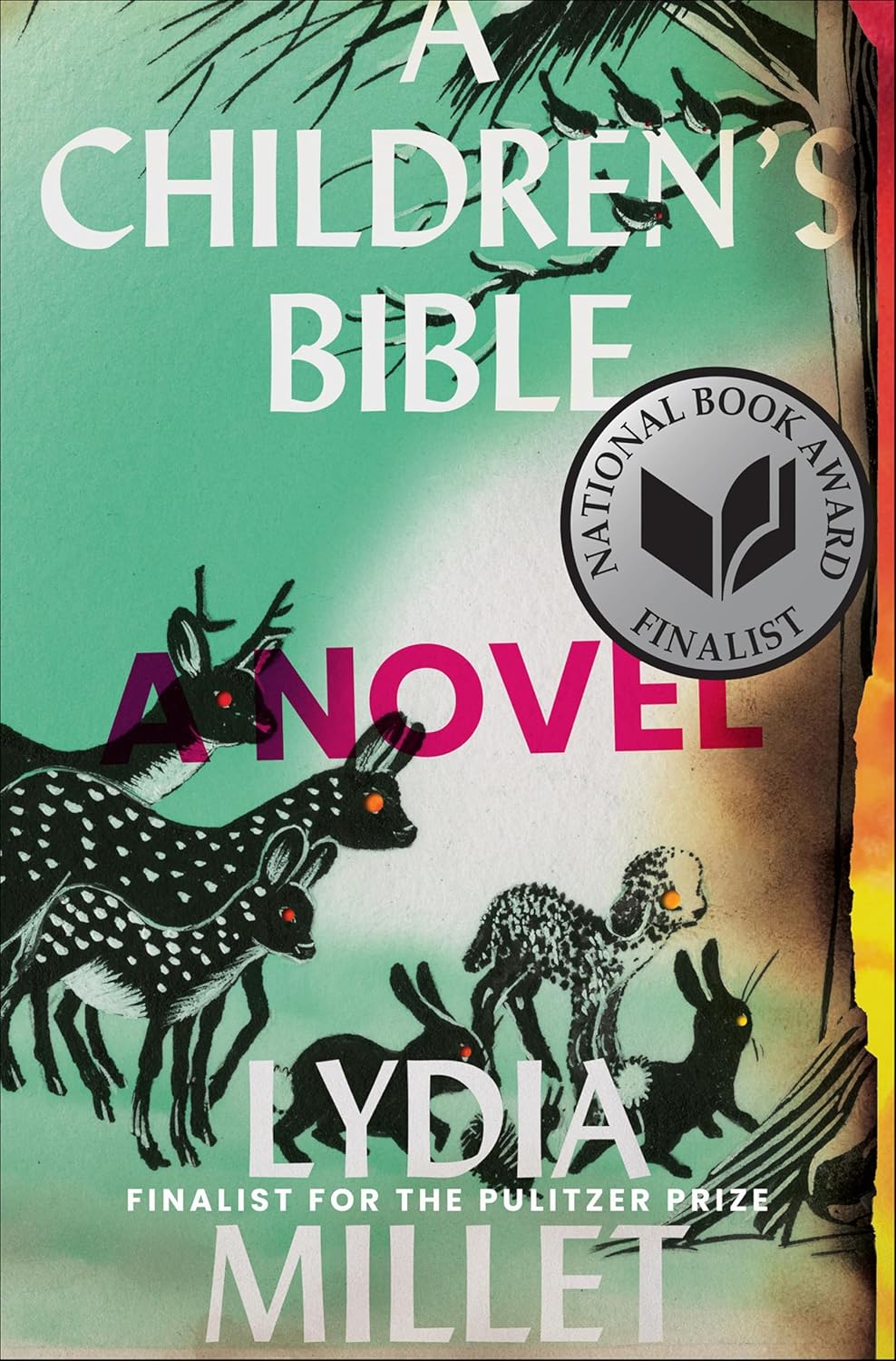
A Children’s Bible: A Novel by Lydia Millet
Lydia Millet has spent much of her career writing about the American Southwest and the environmental pressures bearing down on it, and that context shapes everything she writes, including this book, which is set elsewhere but is unmistakably her.
A Children’s Bible is a short novel about a group of teenagers who spend a summer at a lake house watching their parents drink themselves into irrelevance while the world outside quietly ends. The parents, old college friends who have rented a large house together, move through their days like a liturgy: morning Bloody Marys, beers with lunch, then official “drinking and talking time” at four. The teenagers invent a game where they hide which parents belong to them, which works mostly because the parents are not paying attention anyway. Then a storm comes, the house floods, the parents collapse into drugs and uselessness, and the kids take the cars and leave. What follows is a genuine apocalypse: no services, no supplies, looting, violence, a group of children building something functional out of rural Pennsylvania because there is no one else to do it.
What Lydia Millet is doing underneath the plot is asking a question her narrator Evie has already answered before the novel begins. “We knew who was responsible,” Evie says of the climate disaster closing in around them. “It had been a done deal before we were born.” There is no suspense about blame here, which is part of what makes it different from most literary fiction about ecological collapse. The moral accounting is settled. What remains is the question of how you live inside a catastrophe you inherited, how you raise each other when the adults have opted out. It is also frequently funny, which matters. Millet trusts you to hold the comedy and the dread at the same time, which is the only honest way to write about any of this.
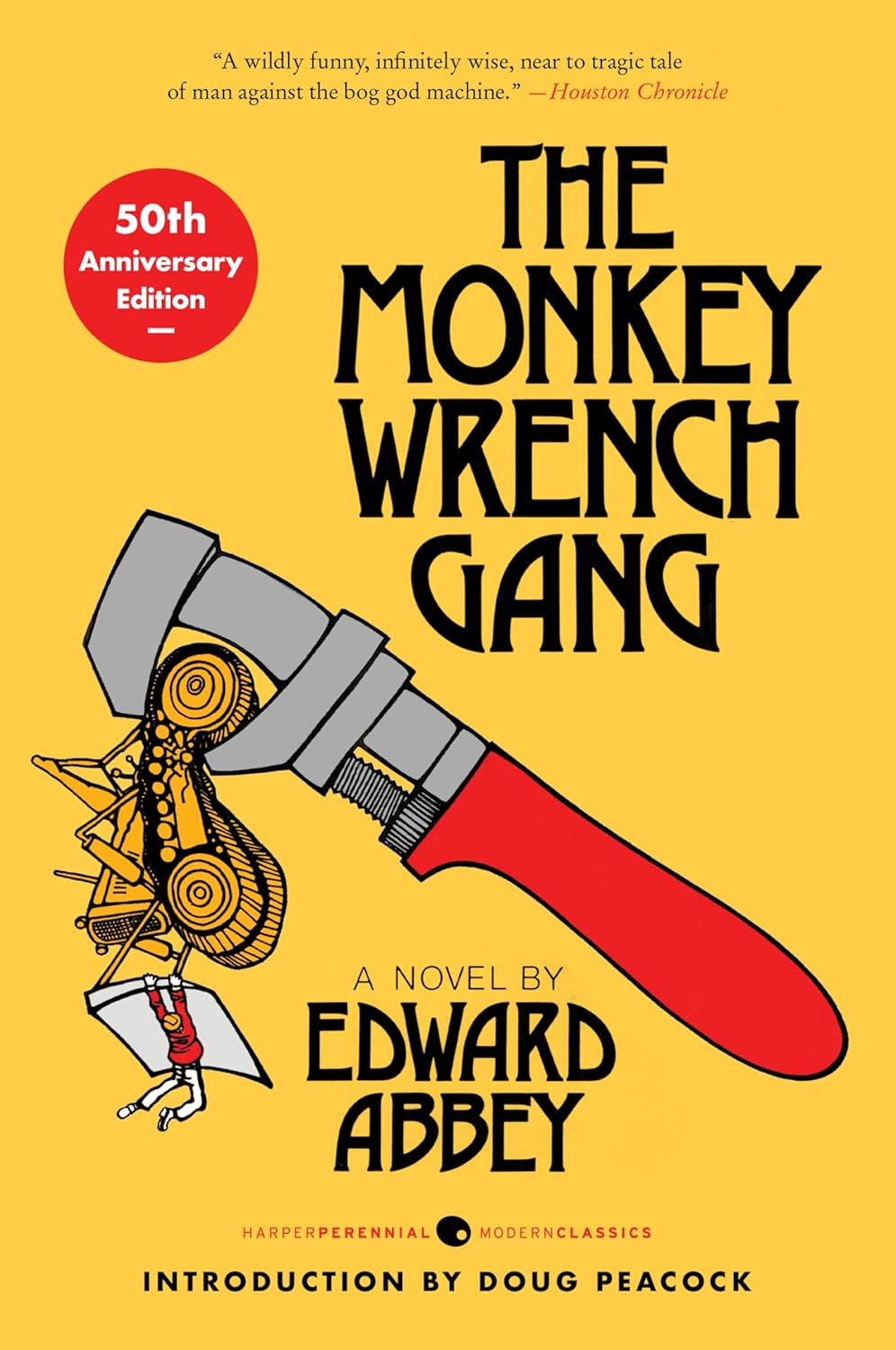
The Monkey Wrench Gang by Edward Abbey
George Hayduke comes home from Vietnam to find the Southwestern desert being eaten alive by industrial development. Strip mines, dams, highways, clear-cuts. He is not interested in filing complaints. He falls in with three others who share his appetite for direct action: Bonnie Abzug, a feminist saboteur transplanted from the Bronx who has no patience for the wilderness mythology that draws men like Hayduke; Seldom Seen Smith, a wilderness guide and lapsed Mormon with three wives and a grudge against every dam ever built; and Doc Sarvis, a wealthy libertarian surgeon who relaxes by torching billboards along the highway. The four of them spend the novel doing real damage to the machinery of development in the American Southwest, and Abbey makes it funny, propulsive, and morally serious all at once.
The question underneath it is a genuine one: what do you do when legal channels fail the land? Fifty years later it still does not have an easy answer.
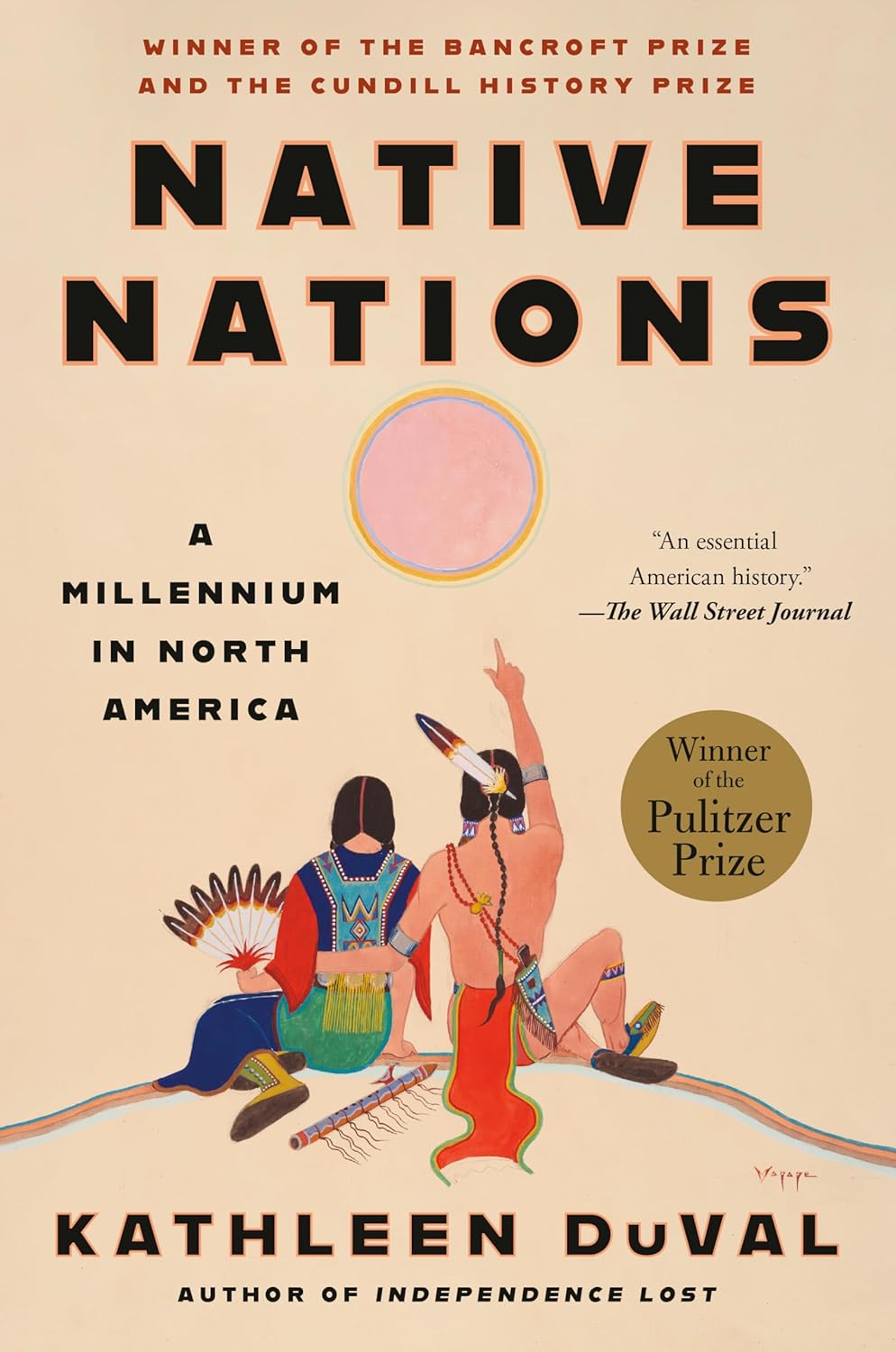
Native Nations: A Millennium in North America by Kathleen Duvall
The first part of Native Nations, the Pulitzer prize winning history of a millenium of native nations in the United States, begins in Arizona, where dense, irrigated, politically organized urban civilizations existed centuries before Europeans arrived. Between roughly the tenth and twelfth centuries, the Huhugam (known in older literature as the Hohokam) built large farming towns along rivers and canal systems capable of supporting populations of around ten thousand people in some areas. Casa Grande is the most visible remnant, but the evidence is everywhere: platform mounds, ball courts, canal networks, large village sites. The myth that no major Native civilizations existed north of central Mexico is not a misreading of the evidence. It is an avoidance of it.
By the early fifteenth century, well before sustained European contact, many of these cities had depopulated or reorganized. DuVal attributes this to a combination of elite political overreach and the climate pressures of the Little Ice Age, which stressed the irrigation systems that made the whole thing work. What followed was not collapse but transformation: people shifted toward smaller, more dispersed communities organized around reciprocity and flexible alliances rather than centralized authority. The O’odham who eventually encountered Spanish colonizers were not a remnant population living simply in the desert. They were the descendants of urbanists, drawing on a long and complicated political history, and they engaged the Spanish accordingly: selectively, strategically, on their own terms where they could manage it.
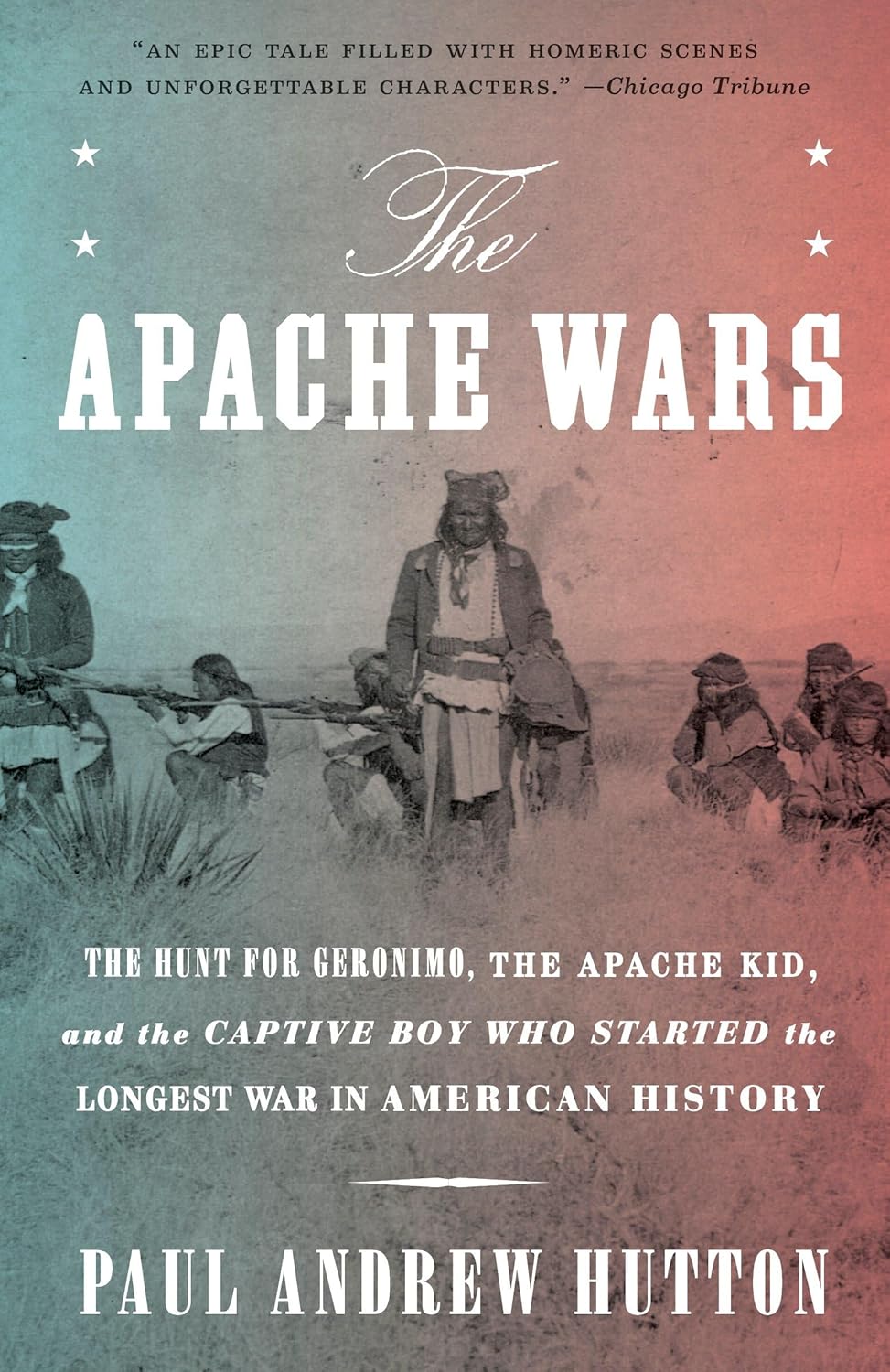
The Apache Wars by Paul Hutton
The Apache Wars lasted from 1861 to 1886, and Paul Hutton’s book locates their starting point in a single kidnapping: a half-Irish, half-Apache boy named Mickey Free, taken by Apaches in a case of mistaken identity that set off a chain of retaliations that neither side could stop. Free grew up among the Apaches, became a scout, and ended up serving the U.S. Army in its campaign against the very people who raised him. Geronimo, according to Hutton, feared only one man. It was Free.
The book is a collective portrait more than a biography. Hutton moves through the major figures on both sides: Cochise, Mangas Coloradas, Victorio, and Geronimo on the Apache side; Kit Carson, George Crook, and Nelson Miles among the soldiers; scouts, frontiersmen, and the Apache female warrior Lozen, who is one of the more remarkable people in a book full of them. What holds it together is a clear argument about what the Apache Wars actually were: not a series of skirmishes but a sustained campaign of destruction against a people who had lived in the Southwestern borderlands for centuries, fought to the end with what they had, and lost. By 1890 the frontier was declared closed. The Apaches were imprisoned or on reservations. Hutton does not let you forget what that cost.
Now I Surrender by Alvaro Enrigue
Now I Surrender opens with a woman running. Her husband is dead, his ranch has been raided by Apaches, and she is alone in the desert with whatever she could carry. From there Álvaro Enrigue builds outward across time: a lieutenant colonel chasing cattle rustlers who finds himself tracking something stranger; the American and Mexican militaries decades later trying to engineer Geronimo’s surrender while managing their own political exposure; and a contemporary family traveling through the same borderlands looking for a version of the past that official history has not already flattened. The novel moves between these threads without fully resolving them into each other, which is the point.
The border between Mexico and the United States in this book is not a line but a wound, contested and recontested by armies and governments who needed the land to mean something different than it did to the people already living on it. The Apache presence at the center of the novel is not backdrop; it is the measure against which every other claim gets tested. Enrigue wrote his way through this material in Spanish, which adds another layer to what the book is asking about translation, ownership, and who gets to tell a story about a place.
Tony Hillerman novels
Tony Hillerman wrote 18 novels in his Navajo Tribal Police mystery series, starting with The Blessing Way in 1970 and ending with The Shape Shifter in 2006. The central detectives are Joe Leaphorn and Jim Chee, and the books are set in the Navajo Nation across the Four Corners region. For decades, various attempts were made to adapt them for television. Eventually George R.R. Martin and Robert Redford got it done. The result is Dark Winds, now in its fourth season, starring Zahn McClarnon as Leaphorn and Kiowa Gordon as Chee, with one novel per season.
The scenery is filmed largely in New Mexico and it is genuinely beautiful, the kind of landscape that makes you understand why Hillerman spent 36 years setting stories there. The acting carries the show, and McClarnon in particular is worth watching in any scene he is given.
This post is part of the Top Ten Tuesday book blog link up hosted by Jana at That Artsy Reader Girl. This week was a post what you like week.
Tags
Respond
Quick Lit: Short and Sweet Reviews — January 2026
A grumpy bookseller novel, Lydia Millet’s razor-sharp short stories, Joy Harjo as the wise auntie we all need, and a strange new Roxane Gay–imprint release about grief, obsession, and the soul of a dog.
New-to-me Authors Read in 2025
A Top Ten Tuesday list of new-to-me authors I read in 2025, plus the real question underneath: was I pulled in by the author, the premise, or the hype, and did the book deliver?
The Man Who Could Move Clouds by Ingrid Rojas Contreras
Mami says she lost the gift of seeing ghosts when my sister was born, and the gift of hearing voices when I was born, but in the wake of her decreased power, she retained the ability to foretell the future, as well as the eerie yet modest talent of appearing in two places at once.